Friday, August 24, 2012

#BlogElul: A Little Faith

Recently, I was talking with a congregant about a project that she had been working on, long and hard, for months. She had decided on a course of action that might lead to the best possible conclusion of her project, but that also could, just as easily, lead to the undoing of all the effort she had put in. I pointed this out, suggesting that by following this course of action she might find herself quickly back at square one.  I will never forget her reply.

"Oh, but Rabbi," she exclaimed, "I believe God provides! Don't you?"

Instantly, I felt both humbled and grateful for this impromptu lesson in faith. My personal theology does not ever lead me to make statements such as, "I believe God provides." But it does require me to remember, every once in a while, that some things are beyond our control, and that we need to have a little faith that somehow things will work themselves out in the end; that releasing our death-grip on life and giving over a little responsibility to God, or the animating energy of the universe, or whatever (or whomever) it is that you credit for all the world's unsolved mysteries, we will eventually find our way to some meaningful coincidence of events.

I haven't seen the movie The Best Exotic Marigold Hotel, but I have heard enough about it to have adopted what is arguably its most famous line:  “Everything will be alright in the end… if it’s not alright then it’s not yet the end.” I have always believed this strongly: somehow, things will work out. We may not love how things work out, we may not have chosen the way things end up working out, but one way or another, we will be alright. We will find our way, our plan B, our new normal. So why not relax, once in a while, into the arms of this...faith?

A friend of mine once told me that when her small granddaughter would cry, whether from a scraped knee or a bruised ego or a frustrated will, she would hold her and rock her and say, "It will be better soon." There are no guarantees that things are going to turn out the way we want or the way we planned, but if we allow ourselves our hurts, our disappointments, and then allow ourselves to heal, well--it will be better soon.

I need to remember all this more often. For example, when I feel beset by bad news, by a proliferation of the ugly side of human nature, whether in world events or at my own dining room table. I need to remember this as I prepare for Yamim Nora'im, the Days of Awe, as I consider all the times I have truly repented and then sinned again. There's still the good. Even if we've failed before, we still might succeed this time. We can make change in the world, even if we can't take responsibility for changing the whole world, all at once.

As for risk-taking? What other option do we have? The most conservative, cautious person in the world still has her plans blow up in her face now and then. The world is unpredictable. Our lives can change in a second. But have a little faith. It will be better, soon.

This post is part of #BlogElul, created and organized by Ima on (and off) the Bima, who writes:


The Jewish month of Elul, which precedes the High Holy Days, is traditionally a time of renewal and reflection. It offers a chance for spiritual preparation for the Days of Awe. It is traditional to begin one’s preparation for the High Holy Days during this month with the Selichot, the prayers of forgiveness. We look to begin the year with a clean slate, starting anew, refreshed.


Visit The Ima or follow her on Twitter to see others' contributions, and please return (!) here, where I plan to share one or two thoughts before the month is through.


Sunday, August 19, 2012

#BlogElul: Return In Love


Image shamelessly copied from my blogging mentor Rebecca Einstein Schorr

Today is Rosh Hodesh Elul, the beginning of the month that brings us to the doorstep of the most sacred days in the Jewish calendar, outside of the regular and profound holiness of Shabbat. Yamim Nora’im, or Days of Awe,  begin with Rosh Hashanah, the Jewish New Year, and end at the conclusion of Yom Kippur, ten days later.

Today also happens to be my eleventh wedding anniversary. Eleven years ago, August 19th fell on the Rosh Hodesh Elul, as well.*

Aleph, lamed, vav, lamed. These are the Hebrew letters that spell the name of the month Elul. Which, in turn, forms an acrostic for “Ani ledodi vedodi li.” I am my beloved’s, and my beloved is mine: words from Tanakh, the Bible, Song of Songs. A passionate poem of love, manifestly describing the relationship of two human lovers, it was read by the sages of our tradition as an allegory, describing the relationship between God and God’s beloved Israel.  Passages from Song of Songs are also traditionally sung at a wedding.

Return, the literal translation of teshuvah, repentance, is the central theme of the season that begins today. It being my anniversary, my thoughts naturally return to that day in August 2001 when I became my beloved’s and he became mine, in holiness, in faith, in the presence of God and our community. I remember the joy of that day, and also the innocence of it. Not only my own, though that was notable, for although Alec and I had known each other over five years by the time we married, had been in a serious relationship with each other for much of that time, and had already helped each other navigate several difficult life passages together, I had no idea of the depth of challenges yet to come that would test us and our love for one another.  

But that was still several years off. As we stood under our huppa, and rejoiced with so many of our dearest friends and family, and flew off to our honeymoon in the Canadian Maritimes (without anyone asking us to take off our shoes or remove liquids from our luggage) a terrible and tremendous loss of innocence loomed for our country, indeed for much of the world. Three weeks later, the world changed, dramatically.

It still amazes me to consider how much has changed since Rosh Hodesh Elul 5761, that August day in 2001. We all have lost so much—individually, as a society, both materially and spiritually—and yet, ineluctably, we have gained. Babies have been born, degrees earned, milestones achieved. Some battles for justice have been won, and new ones taken up. Technology and human knowledge advance at an incredible pace, and yet, at the same time, poverty increases, and freedom by some measures diminishes. Tens of thousands of people still die in hospitals every year because someone neglected to use soap and water between patients; others die because they have no access to medical care in the first place. We gain insight, and yet we continue to have the same arguments with our loved ones, over and over again, about matters large and small. Nation still lifts up sword against nation; every time, humanity and the universe sustain wounds that may never heal, and a path to peace grows ever more elusive. We have gained, and we have lost, greatly.

So here we are, again, at the beginning of this season of repentance, and we are asked, commanded, even, to “return.” Return to our true selves. Return to some sort of original purity. “Renew our days as of old,” we pray.

Is return possible? What would that even look like?

We do not wish to give up some of the ways in which we have changed over time, our increased discernment, even wisdom, hard-won by experience. We cannot erase our scars or others’, though we might wish to. There are things we can never take back, or give back.

When I think of “return” in the context of teshuvah, in the context of Rosh Hodesh  Elul, I think,  perhaps inevitably, of the words “Ani ledodi vedodi li,” I am my beloved’s and my beloved is mine. There are so many ways in which we cannot recapture our lost innocence. But today I think there is at least one way in which we can. It is the way of love. Of rekindled passion, and compassion. Of renewed hopes.

Just as a long-married couple can, through love and generosity, remorse and forgiveness, feel again the joy and gratitude and excitement they felt on their wedding day at the sheer wonder and blessing of the connection they share, so can we return to the wonder we experienced "of old," with God, however we understand God. Our relationship with God, after all, mirrors our relationship with the rest of creation: the earth and its inhabitants, humanity, the universe. We can return, in love, in compassion, in our commitment to tikkun olam—to making the world a better place. We can return, through forgiveness and love, to a version of ourselves and our relationships that we may have thought lost.

Jewish tradition encourages us to do this every day, every moment: live each day as if it may be your last—because it may be! But as this becomes difficult and exhausting, as we are imperfect and forgetful, our tradition gives us a big wake-up call each year. With the blast of the shofar, with the new moon, with Rosh Hodesh Elul. we are called to return. We are called to return to our beloved: family and friends, God, our self. 

Here is the task, and the promise, of our season of repentance. How will you return? We have 40 days to figure it out.

*Alec and I were married on the 30th of Av, which fell yesterday on this year's secular calendar, but it was, nevertheless, Rosh Hodesh Elul, which is always a two-day celebration.

 This post is part of #BlogElul, created and organized by Ima on (and off) the Bima, who writes: 
The Jewish month of Elul, which precedes the High Holy Days, is traditionally a time of renewal and reflection. It offers a chance for spiritual preparation for the Days of Awe. It is traditional to begin one’s preparation for the High Holy Days during this month with the Selichot, the prayers of forgiveness. We look to begin the year with a clean slate, starting anew, refreshed.

Visit The Ima or follow her on Twitter to see others' contributions, and please return (!) here, where I plan to share one or two thoughts before the month is through.


Sunday, August 12, 2012

The Thickening Around Your Hearts

The following is an adaptation of my d'var Torah from this past Shabbat.

Outside the Sikh Temple in Oak Creek, Wisconsin, last week
image found at msnbc.msn.com
The Sikh Temple shooting has received so much less coverage, so much less outcry, than the mass shooting less than two weeks earlier in Colorado. Is it the Olympics? Compassion fatigue? Or is it plain old racism, or xenophobia?

Or, is it something less sinister but more insidious than that? Is it simply that average Americans can’t relate because, as Robert Wright wrote in The Atlantic, “They can imagine their friends and relatives—and themselves—being at a theater watching a batman movie; they can't imagine being in a Sikh temple.”

As a Jewish community, perhaps we can relate better. We are, after all, a minority people and religion in this nation and all others around the globe but one. And so we have stories like this from JTA, and this press release and blog entries such as this and this from the Religious Action Center of Reform Judaism.

Still, I wonder how many of us followed the news of the Wisconsin temple shooting with the same level of interest as the Colorado theater shooting coverage.  After all, Jews are not Sikhs. We get top billing in the great “Judeo-Christian tradition” so many Americans are fond of claiming, and thus strike most Americans as not nearly as foreign as our Sikh brothers and sisters, with their turbans and their saris and their little-known eastern faith. The Sikh temple shooting is tragic, sobering, but I can imagine there were a few of us out there getting back to business as usual after breathing a secret prayer of thanks that it wasn’t one of our temples.

Except that, essentially, it was.

The day of the Sikh shooting in Oak Creek, Wisconsin, I wrote a prayer that concluded, “We’re all in this together.”

When things like this happen in our country, a nation that we celebrate for its embrace of “liberty and justice for all,” we’re all implicated. And we’re all in danger. Because when one group in our society becomes the target of hateful acts for who they are, everyone’s rights are in danger. And all of us are responsible for speaking out against such persecution.

Several media outlets and commentators have observed that there has been an increase in attacks on Sikhs and Sikh communities since 9/11, because many people mistake Sikhs for Muslims. Does that mean this shooting would have been less tragic had the white supremacist gunman shot down innocent Muslims instead, the presumed “proper” target of his attack?  

We’re all in this together. On Monday, the day after the Sikh temple shooting, a mosque was burned to the ground in Joplin, Missouri. It hardly received any press. Since then, mosques and Muslim worshipers in California, Rhode Island, and Illinois have been targets of vandalism or violence. I had to search for these stories to find them. It is an outrage, a string of events that should cause us to feel shame—as Americans, but also as Jews. Not because as Jews we are in any way more responsible for these events than anyone else, but because as Jews we are particularly warned against this sort of unconcern and blindness.

This week’s Torah portion, Eikev, chronicles one of Moses’ final speeches to the Israelites as they muster on the east side of the Jordan River, preparing at last to enter the Promised Land. Moses exhorts the people to remember how much they have been given:


When you have eaten your fill and have built fine houses to live in, and your herds and flocks have multiplied, and your silver and gold have increased, and everything you own has prospered, beware lest your heart grow haughty...and you say to yourselves, “My own power and the might of my own hand have won this wealth for me.” (Dt. 8:12-14,17)

At one point in his discourse, Moses literally tells the people, “don’t think it is because of your virtue that you will possess this land” (Dt. 9:5) rather, he continues, it is because of the virtue of their ancestors, of Abraham, Isaac, and Jacob, and, moreover, it’s because of the wickedness of its current inhabitants. Try that on for size, and see how it feels. Did we choose our ancestors? Have we never behaved wickedly? Remember the Golden Calf, Moses reminds the people? See those people you are about to dispossess? See those people less prosperous than you? Poorly housed? Poorly fed? But for the grace of God, we are them. They are us.

Our Torah text continues: what does God want from us? God wants us to do the right thing. To remember that there is, essentially, no ethical difference between ourselves other people. Fortune? Misfortune? The luck of the draw. A turn of the wheel. God wants us to empathize with everyone:


Cut away, therefore, the thickening around your hearts, and stiffen your necks no more. For the Lord your God...shows no favor and takes no bribe, but upholds the cause of the fatherless and the widow, and befriends the stranger, providing him with food and clothing.  You too must befriend the stranger, for you were strangers in the land of Egypt. (Dt. 10:16-19)

And, as we should well know, we might easily become strangers again. Befriend the stranger.

Can this feel overwhelming? Yes, it can. Can we solve all the world’s problems? Not alone, and not all at once. As Rabbi Tarfon taught, “Yours is not to complete the task; neither are you free to desist from it.” We can send letters of solidarity, letters to the editor, material and monetary donations, to help those suffering all around us. We can ask questions, vote, march, organize. We can talk about things we usually avoid talking about. We can look at faces we usually avoid looking at. We can seek out the stories we might otherwise not hear.

“Cut away...the thickening around your hearts” is a loose translation of the Hebrew umaltem et orlat levavkhem—literally, "circumcise the foreskin of your hearts." Remove that protective layer. Make yourself vulnerable. What have you got to lose? We’re all in this together.

How will you circumcise your heart?

Sunday, August 5, 2012

The Temple Shooting: A Prayer For All Of Us

I can't think of today's shooting at the Sikh temple without feeling sick
and hopeless
for all of us:
victims, perpetrators, onlookers;
both physical and spiritual,
literal and figurative.

And so, a prayer.

For all of us, strength: to survive, to heal, to love, to change, to work.
To keep battling ignorance and hatred.
To find a better way.

For all of us, compassion: to forgive, to grow, to change, to love.
To heal.
To mend every broken heart.
Together.
We're all in this together.

Friday, June 22, 2012

A Letter Home, A Voyage Out


The following was written for and featured in the URJ Jacobs Camp Blog. My daughters and I are in the midst of our annual Jacobs Camp experience. Wish you were here!
First Letter from Camp

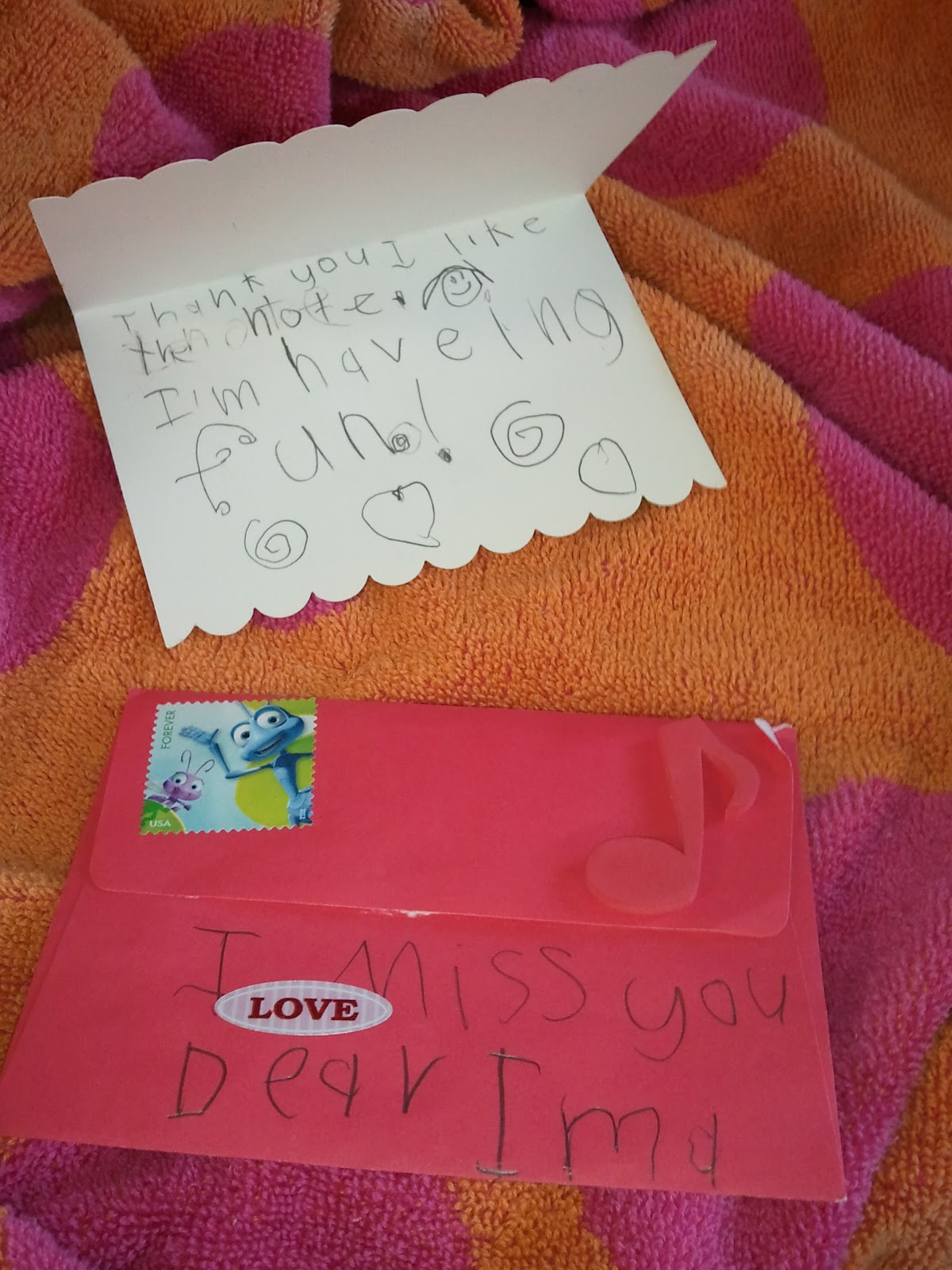
Today I received my first-ever camp letter.

Written by my oldest child, it is unmailable. It bears no address beyond “I miss you Dear Ima” printed in pencil on the back of the envelope. It is stamped, on the upper left corner of the back of the envelope. It also sports a 3-D foam sticker on the outside of the envelope. I’m not sure how the Postmaster General feels about 3-D adornments on the outside of envelopes sent through the U.S. Postal Service, but I’m guessing it’s not good.  Fortunately, I’m at camp, so I received this (by some measures deficient) missive during lunch at the staff table without any trouble.

(Note to first-time camper parents, especially younger first-time camper parents: don’t just provide the address labels and stamps when you send your child to camp. Put them on the envelopes. Or, at the very least, provide your child with a template showing where the address and stamp should go. And drill your child in its correct use in advance of the first day of camp. The image you have of an orderly cabin-wide letter-writing session, concluding in the children addressing and stamping their envelopes under the direct supervision of a counselor, doesn’t happen.  With deep appreciation and respect for the wonderful counselors: I’m not sure exactly what does happen, but it’s not that.)

Everything about this short, sweet, incompetently posted note warms my heart. I’ll be keeping this one forever.

I know I’m lucky. As a rabbi on faculty at Henry S. JacobsCamp, I get to spend a week here each year, and each year, my kids come with me. Previously, they’ve roamed camp with a babysitter while I worked and played with the campers. This year, my daughters are campers, too: one in Olim, the other enjoying her first spin with K’tanim, Jacobs’ week-long day camp for 4- to 6-year-olds.

True, I have a lot more access to my kids than other camp parents do. Still, I don’t really know what they’re up to for the most part, outside of what they or their counselors might tell me in letters, in hurriedly brief verbal reports, or after the whole thing’s over next week. I’m busy teaching older students, or planning a service, or angling for a chance to climb the Tower when it won’t interfere with the campers’ scheduled activities.  Not to mention, when it comes to my Olim camper (as opposed to anyone else’s!), extensive interaction is not encouraged. A quick hug at mealtimes, often just a wave, is about all I hope for.

Reply
Also true, this gap in my knowledge of my children’s experience is not unprecedented. Since each of them was only a very few months old, I’ve left them in the care of others for significant periods of time each day while I worked.

And yet, this is the first time either has been away from me most of the day and all night, not for one or two nights at a friend’s or with Bubbe and Poppy, but for ten nights. It’s the first time my oldest child is having an extended, significant, potentially life-changing experience without me.

As a parent of very young children, this milestone is, admittedly, bittersweet.

Letting go of the all-encompassing nature of the early parent-child relationship means letting go a bit of the euphoria and intense intimacy of this phase of parenting.

But I don’t mind the idea of letting go some of the physical exhaustion and intensely irrational exchanges of this stage of the relationship (I know, I know, the irrational part will be back in a few years….) And how proud are we parents of our first-time sleep-away campers for their newly discovered and expanding repertoire of emotional, physical, and social skills; their growing independence?

As a rabbi, all of this—my oldest daughter’s camp experience, its impact on her development and our relationship—reminds me of Torah. Of course.

The stories of our matriarchs and patriarchs, of Moses and the exodus from Egypt, of the years of wandering in the wilderness—these stories are terse, elliptical, with many details of time, space, characterization, and other narrative elements left blank. This might have frustrated our ancestors; we may have been driven away from this confounding tradition before it properly began. Instead, our sages, and Jews to this day, have filled in those gaps with wonderful and wondrous works of midrash, a genre of classical rabbinic and contemporary literature that answers the questions these blanks suggest.

The phenomenon of midrash, both the body of work and the act of creating it, has infinitely enriched, complicated, and nuanced our relationship with Torah. Were all the answers already provided, every detail known, would the text have drawn us as powerfully and as eternally as it does? Would we be tempted into hours, years, of study, reflection, argument, and discussion about what it means? Our knowledge of such a Torah might be more complete, but almost certainly more superficial.

My daughters have always had to come up with their own midrash on my life. They’ve asked and imagined stories to fill in the blanks of their knowledge of me, both the years before they were born and the times since, when I’ve left them in another’s care, certain of where to find them when I returned, while I went gallivanting off, from their perspective, who-knows-where to do who-knows-what.

In one incremental way, this summer, my relationship with my daughters grows a tiny bit more balanced, anticipating the day when we will relate to one another as adults, as equals. It grows a little deeper as they begin to collect their own private stories and mysteries, ideas and opinions, fuel for a lifetime of study, reflection, argument, and discussion.  I can’t wait to see where it all leads.

Sylvia’s letter from camp is the perfect beginning to this journey.

Monday, April 2, 2012

Ask Three Rabbis


For nearly two years now, I have been serving on the Jewish Values Online Panel of Scholars.  Here's how it works: you (or anyone with access to the site) submits a question. The question is assigned to three scholars, from three different streams of Jewish tradition (OrthodoxConservativeReformReconstructionist, etc.). Each panelist submits an answer. You've heard of two Jews, three opinions? It's kind of like that, only more so.

I posted my latest response today, to this question: Should we still be spending time and resources on prosecuting Nazi war criminals, many of whom are old and sick? 


Sunday, April 1, 2012

All Prisoners, All Free

#BlogExodus: Freedom

I originally wrote a version of this post for the April 2012 Hebrew Union Congregation Temple Topics, our monthly bulletin.
Image found at theyeshivaworld.com


I have never led a Passover Seder in a prison, but each spring, as we begin our extensive preparations for the holiday, I find myself wondering: what would that be like? I consider the question with an uncomfortable curiosity, a combination of longing and aversion.

Passover is our festival of freedom, our celebration of Israel’s storied redemption from slavery in Egypt. In every generation, we read in the Haggadah, our guide to the Seder, each of us must feel as if we, personally, had come out of Egypt. As if we ourselves tasted the sweetness of liberation after long oppression. In the traditional text we recite:
Therefore, let us rejoice
At the wonder of our deliverance
From bondage to freedom,
From agony to joy,
From mourning to festivity,
From darkness to light,
From servitude to redemption.[1]

And yet, the Seder also reads: “Now we are all still in bonds. Next year may all be free.”[2] 

I wonder how the first passage might sound to a convict in prison, a homeless person, a political captive, anyone whose existence is dominated by oppression, loss, or suffering.

And I wonder how the second text is heard by those of us whose existence is dominated by blessing: physical comforts, political freedom, the love of family and friends.

My first thoughts always go to how painfully our traditional words of celebration and gratitude must prick those who find themselves in bitter circumstances, and to how unthinkingly the formulaic words of persistent bondage, of incomplete redemption, must roll off the tongues of those whose lives are sweet.

Yet I know it is not necessarily so. I know there are people in the most terrible of circumstances who, like Viktor Frankl in the Nazi concentration camps, still maintain the inviolability of ''the last of the human freedoms, to choose one's attitude in any given set of circumstances, to choose one's own way.''[3] And I know there are those who, in the midst of personal well-being, maintain a consciousness of our broken world, an appreciation of the idea that none of us is redeemed, none of us truly, wholly free, until all are free.

Might we aspire simultaneously to both of these truths? That in the midst of oppression, we maintain a certain freedom, to transform the future and change our lives; and that in the midst of blessing, we maintain a sense of our responsibility for those less blessed? This year, when we conclude our Seder with the traditional cry, “Next year in Jerusalem!”—next year in the messianic age of peace and justice, next year may we be free, redeemed from every Egypt—might our words should truly reflect our intentions (if not our expectations), and guide our future actions? May it be so, at all of our Seders, wherever they may be.

Image from Teshuvafilm's Blog
In the mean time, I intend to find out whether any Mississippi prisoners are in need of an in-house Seder this year.  

This post is part of #BlogExodusa pre-Passover initiative started by rabbi, mom, & friend Imabima. To see more blog postings on Passover themes, follow #BlogExodus on Twitter.


[1] Translation from BaskinHaggadah, Revised Edition, CCAR 1994.
[2] Ibid.